Sciatica
If you’ve experienced sciatic pain, you know it’s unlike most other pain. It can travel — from your lower back through your hip, down your leg, sometimes all the way into your foot. It can feel like a dull ache, a sharp shock, a burning sensation, or a numbness that comes and goes without warning. And for many people, it tends to get worse over time.
Sciatica is one of the most common conditions we see at Cornerstone. It’s also one of the most misunderstood — and one where the right care, applied at the right time, can change the trajectory significantly. We’re here to offer kōkua — real support, real answers, real relief.

Ready to Experience Relief Your Sciatica?
Sciatica Didn’t Start When You Felt It
Most people can point to a specific moment when the pain began — bending over to pick something up, getting out of the car, maybe reaching for something overhead. It feels sudden. But in almost every case, the sciatica had been developing quietly for months or years before that painful moment.
The sciatic nerve is the longest nerve in the body, running from the lumbar spine and pelvis all the way down through the leg. When the vertebrae or discs in the lower back shift out of alignment and begin placing pressure on that nerve, the body compensates — sometimes for a long time — before the pain becomes impossible to ignore.
What We’re Looking For When You Have Sciatica
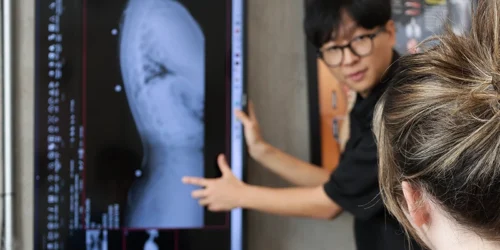
The lumbar spine and pelvis are complex, and identifying the true source of sciatic irritation requires more than a physical exam. At Cornerstone, we use detailed X-rays and thermography to see exactly what’s happening structurally — which vertebrae are misaligned, how the discs are positioned, and where nerve interference is occurring. That precision is what allows us to correct the cause rather than chase the symptom.
On Surgery — and Why Most People Don’t Need It
Back surgery is far more common in the United States than it should be — and the outcomes are sobering. Research suggests spinal surgery is effective in only about 15% of cases over a five-year period. That’s a significant intervention with a low success rate. For the vast majority of sciatica cases, the issue is structural and correctable through precise, conservative chiropractic care.
How We Approach Sciatica at Cornerstone
Once we understand what’s driving your sciatica, your care plan is built around our 3-stage Foundational Correction model:

Foundational Ergonomics
To manage your sciatica, we identify your daily habits, postures, and movement patterns that are loading your lumbar spine and contributing to sciatica nerve compression. Practical changes here protect the progress you make in clinic.
Gonstead Chiropractic
Precise, segment-specific adjustments guided by your imaging improve your sciatica condition. We focus on restoring proper position to the vertebrae and discs placing pressure on the sciatic nerve — without generalized, conventional manipulation.

Foundational Movement
Spine-specific exercises tailored to your X-rays help stabilize your corrections, support disc health, and reduce the risk of sciatica flare-ups over time.
The Good News About Sciatica
Recovery time varies — it depends on how long the condition has been developing and how significant the structural changes are. But here’s something we tell our patients consistently: it almost always takes less time to correct than it took to create.
Choose a location to book your first appointment:
Ewa Beach
(808) 321-0253
91-1123 Keaunui Drive #228
Ewa Beach, HI 96706

Kapolei
(808) 321-1540
338 Kamokila Boulevard #207
Kapolei, HI 96707
Kaka’ako
(808) 286-4287
512 Keawe Street
Honolulu, HI 96813
Kailua
(808) 636-6996
600 Kailua Rd #124
Kailua, HI 96734