
Plantar Fasciitis
That first step out of bed in the morning — the sharp, stabbing heel pain that makes you wince before your day even begins — is one of the most recognizable signs of plantar fasciitis. It’s a condition that affects an enormous range of people, from dedicated runners to those who spend long hours on their feet, and it has a way of quietly limiting your life when left unaddressed.
The good news: plantar fasciitis responds very well to conservative care when the source is properly identified and treated. True health starts from the ground up.

Ready to Get Relief from Your Plantar Fasciitis?
What’s Actually Happening with Plantar Fasciitis
The plantar fascia is a thick band of tissue that runs along the bottom of your foot, connecting your heel bone to your toes. When this tissue becomes inflamed — through overuse, poor support, structural imbalance, or a sudden increase in activity — it creates the characteristic heel pain most people describe as worst with those first steps of the morning, then easing somewhat as the foot warms up through movement.
Left unaddressed, plantar fasciitis can progress — and in some cases leads to the development of a heel spur, a bony growth that adds another layer of complexity to the problem.
Why Structure Matters More Than You Might Think
Plantar fasciitis isn’t always just a foot problem. How your weight is distributed, how you walk, and how your knees, hips, and pelvis are aligned all directly affect how much stress is placed on the plantar fascia with every step you take. Poor gait mechanics or structural imbalances higher up the chain are frequently contributing factors that go unexamined when treatment focuses only on the foot itself.
What You Can Do at Home to Manage Your Plantar Fasciitis
Consistent plantar fascia stretching between visits meaningfully supports the healing process. Regular ice massage over the site of pain — applied for no more than 20 minutes at a time, several times daily — can provide relief without medication. Investing in proper arch support and maintaining a healthy weight are among the most effective long-term prevention strategies.
How We Assess Plantar Fasciitis
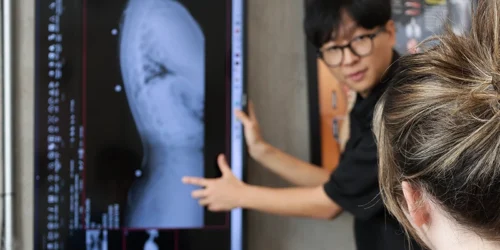
A proper diagnosis involves more than pressing on your heel. We evaluate muscle strength and tone, reflexes, coordination, balance, and gait patterns. We assess weight distribution and structural alignment from the ground up. When indicated, X-rays help rule out contributing factors like heel spurs, fractures, or subluxations that may be compounding the issue.
Our Approach to Plantar Fasciitis at Cornerstone
A comprehensive x-ray guided evaluation looks at both your feet and the cervical spine to get lasting relief.

Foundational Ergonomics
The Cornerstone team looks at your footwear, daily movement patterns, activity load, and how structural habits throughout your body may be placing excess stress on the plantar fascia. Practical guidance on orthotics, arch support, and movement adjustments is part of the conversation.
Gonstead Chiropractic
If spinal or pelvic misalignment is contributing to poor gait mechanics or uneven weight distribution, precise structural correction addresses those upstream factors. Adjustments to the joints of the ankle and foot are also used to restore proper range of motion and reduce tissue stress.

Foundational Movement
While you are in our clinics, you’ll be taught targeted stretching and strengthening work focused on the plantar fascia, calf musculature, and surrounding structures.
Don’t Let It Become a Bigger Problem
Plantar fasciitis is highly treatable — especially when addressed before it progresses.
Book your first appointment to get relief from your plantar fasciitis. Click a location near you.
Ewa Beach
(808) 321-0253
91-1123 Keaunui Drive #228
Ewa Beach, HI 96706

Kapolei
(808) 321-1540
338 Kamokila Boulevard #207
Kapolei, HI 96707
Kaka’ako
(808) 286-4287
512 Keawe Street
Honolulu, HI 96813
Kailua
(808) 636-6996
600 Kailua Rd #124
Kailua, HI 96734